Posts

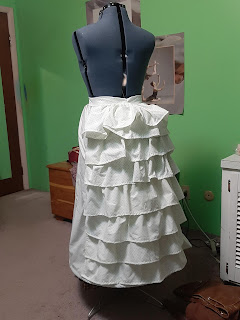
. Truly Victorian Grand Bustle 108
Image
  I like Big Bustles and I cannot lie Materials:  Sheet from Goodwill: $1.50 Boning from an old hoop: $0 Bone casing from goodwill: $50 Pattern: $10.00 Total: $12.50 So this pattern is pretty straightforward. There are four gored pieces that make up the front and are smooth. There is on curved piece for the back, and another piece that is used to pull the ends of the boning together and keep the boned bustle part off your legs.  I did the Truly Victorian Digital patterns that are printed off on the computer, laid out so the sides and matching, then taped together. I then cut it like a regular paper pattern and use it like normal. Like this! So for the next step, cut out all the pattern pieces and put boning channels on the back piece before sewing to the front and sides or putting in the brace piece. I chose to put the ruffles on next before adding boning or doing any more sewing. The instructions said to put the boning channels on the outside but I put them on the inside...

Truly Victorian Parisian Trained Skirt 219 Part 1

Image
Front panels of skirt and Apron The instructions for this pattern are a little confusing but basically they want you to break it up into two parts, decorate those parts and do all the finishing work then sew them together between the side seam and the bustle/train piece.  To start with, take pieces A, B, and C, plus the two aprons. I chose to only do the top apron but the pattern calls for a top and bottom apron.  Yes, it seems weird, but it was 4 am and my sleepless brain thought it was a good idea, along with thinking that the skirt would look cute with a touch of assymetry which was totally acceptable during the 1870's. I guess you could say "we're not in the civil war era anymore toto". Bad jokes aside, lets dig in to the Truly Victorian Skirt 219  Sew together A, and B. This will give you the base skirt which the aprons will be attached to.  Cut the apron pieces and hem the bottom. It is easier to hem before it is sewn on to the base skirt.  Measure out the...

Black Silk dress with Sleeve Jockey Bishop Sleeves

Image
Antique 1860s Distressed Black Silk Gown Dress Civil War Era Victorian Note from Me:   There is a reason that I want to record these dresses. Because of items like this one. Its physical presence is fading, the years have taken its toll on its form and its days on this earth are numbered. Hopefully by keeping a digital record of these items, long after moths and decay have reclaimed this garment, future generations will still be able to learn from the images here. Preservation of knowledge is one of the purest of goals, and it takes things like this. Individuals willing to say this is important and we need to preserve it. So enjoy these images, learn, and pass it on. From the Seller An  antique  Victorian gown  dating  from the 1860s.  Distressed Black Silk Distressed antique condition  Silk is torn, tattered, disintegration  Cotton underlay is in good condition One piece in glossy lig...

Black Velvet quilted Mantle with silk

Image
From the Seller A lovely antique original 1860 to 1870 black velvet cape. The bottom hemline is trimmed with a wide band of black silk moire. The cape has a front button and loop closure. It is lined with green quilted silk. The cape is being displayed over a dress that is being offered in a separate auction.  It is in very good condition.  There are no holes and no age marks. There is one broken loop on the front closure. Shoulders 15 Length 29. From the Industrious Lady The age old question, what is it? Cape, mantle, paletot, wrap, shawl. While it might technically fall underneath the category of mantle which Dictionary.com defines as "a loose sleeveless cloak or shawl, worn especially by women." A wrap on the other hand is more loosely identified as an item of clothing which can be pulled around the shoulders for warmth. Below, Godey's seems to identify a style much similar to the one above as a wrap.

Historical Sew Forthnightly: No Buy July

Image
Historical Sew Fortnightly No buy July: Making a Petticoat from an old sheet What the item is : An 1860's style cotton over hoop petticoat The Challenge: No buy Fabric : 100% cotton Pattern : Self made Year : Early 1860's but it also works for most of the crinoline era Notions: one bone   button, cotton thread. How historically accurate is it?  about 5/10, the shape and the tucks are accurate, but it is machine sewn and a cotton petticoat would normally be pure white rather than a pattern such as this. Hours to complete: About two. 1 hour to sew the main body, 45 minutes to do the tucks, and 15 minutes to do the handsewing and making the button/ buttonhole First worn: Dancing and spinning around the house singing 'Once Upon a December" while the animals ran in terror Total cost: no cost, the sheet was given to me, and the button was reclaimed from another outfit This sheet came with a ruffle and unfortunately before cu...

Moire Dress Part 5: Sleeves, Moire than Meets the Eye

Image
Moire Dress Part 5: Sleeves, Moire than Meets the Eye Oh dear, one of the things that first made me love fall in love with the purple moire dress were the beautiful, quirky, and unique sleeves. Who could have guessed that they would also be the most troubling part of the entire outfit. Part of the problem is that the original dress was made using homemade silk velvet ribbon, and with silk velvet running at more per yard, without selling a kidney modern polyester velvet ribbon was the best option. Although if anyone is willing  my left kidney is very nice. The original sleeve seemed to be composed of the v's on one side being done, then all the v's on the other. However, after spending a full two hours pinning and repinning In the end I decided that the darker orange ribbon just was too stiff and too orange. Switched to this new peach ribbon and it was amzing! great flow and the color seemed to go with the coloring better.